CQDM CONNECT-PHARMA CALL FOR IDEAS: VIRTUAL PITCH DAY
CQDM is pleased to launch a call for ideas for the upcoming CQDM Connect-Pharma: Pitch Day, focused on Advanced Imaging and Spatial Biology for Drug Development. Selected applicants will present their innovations to experts from CQDM’s global pharmaceutical members on December 9, 2026.
Our objective is to bring groundbreaking Canadian research and technologies to CQDM’s pharmaceutical members and facilitate interactions between pharma and the Canadian life sciences ecosystem.
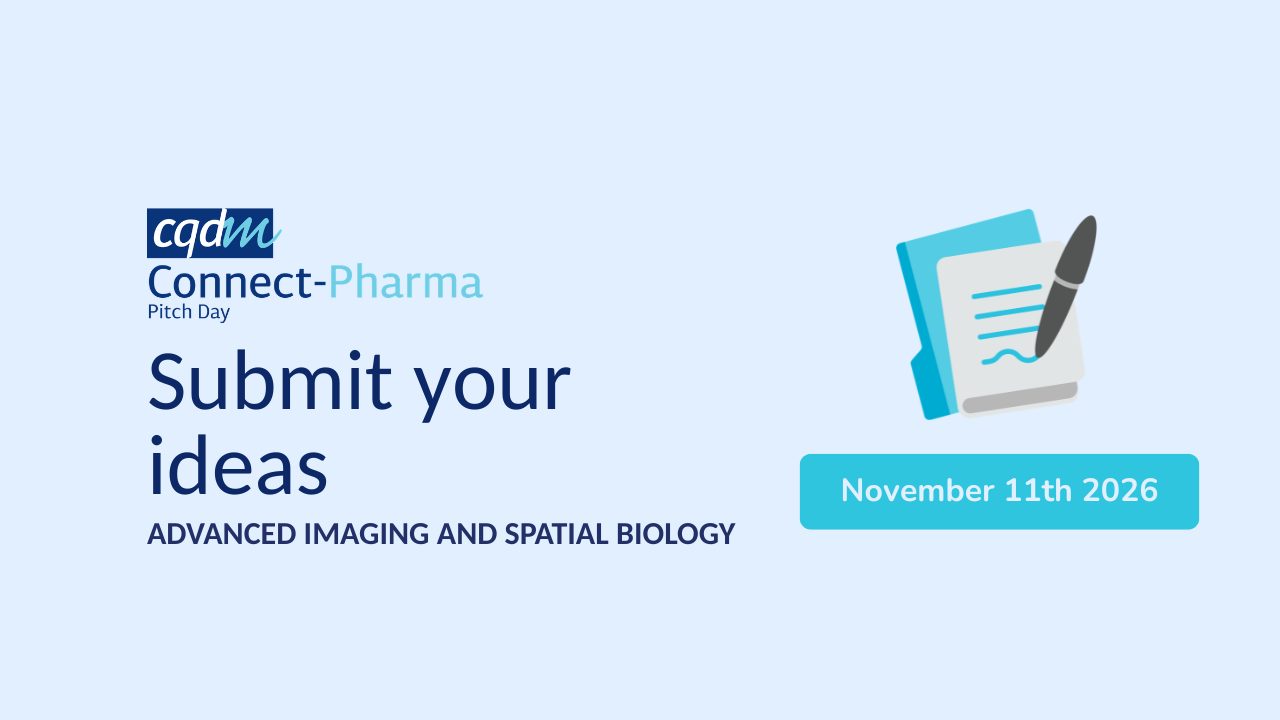
📅 Submission deadline: Wednesday, November 11, 2026
🎤 Virtual Pitch Day: Wednesday, December 9, 2026 – save the date!
📩 Questions? Contact Simon Fournier: [email protected]
Research focus
Advanced imaging and spatial biology are creating powerful new ways to study cells, biomolecules and therapeutic effects within intact tissues. By preserving tissue architecture and spatial context, these approaches can reveal disease heterogeneity, cellular interactions, drug distribution and treatment response that may be obscured by bulk or dissociated-sample methods. This call seeks differentiated technologies and applications that translate these insights into better decisions across drug discovery and development.
Spatial omics and tissue profiling
- Spatial transcriptomics, proteomics, metabolomics, lipidomics, genomics or epigenomics
- Single-cell and spatial multiomics, including multimodal data integration
- Analysis of cellular neighbourhoods, functional niches, tissue heterogeneity and cell-cell interactions
- Three-dimensional spatial profiling and reconstruction of complex tissues
Advanced, multiplex and molecular imaging
- Multiplex or hyperplex tissue imaging and high-content phenotypic imaging
- Super-resolution, light-sheet, intravital, live-cell, whole-tissue or three-dimensional imaging
- Molecular imaging, imaging mass spectrometry, PET, MRI or other modalities directly linked to drug development
- Quantitative imaging of organoids, microphysiological systems and other human-relevant models
- Longitudinal imaging of disease-relevant functional readouts within tissues
- Four-dimensional live-cell profiling to characterize changes in the localization, interactions and functional behaviours of tumour-infiltrating immune cells over time
Digital pathology and AI-enabled analysis
- AI-enabled pathology, virtual staining and prediction of spatial biomarkers
- Automated segmentation, phenotyping and identification of spatial signatures
- Multimodal AI approaches that co-register routine H&E images with spatial omics, molecular, clinical or pharmacological data to generate scalable spatial insights and reduce assay complexity and cost
- Computational pathology and image-based approaches supporting translational or clinical decisions
Spatial pharmacology and therapeutic distribution
- Quantification of drug penetration, biodistribution and localization within tissues or cellular compartments
- Assessment of target engagement, receptor occupancy, target saturation and payload release
- Spatial and spatiotemporal pharmacokinetics and pharmacodynamics, including changes in local drug concentration, microenvironment-specific clearance, target engagement and mechanisms of response, resistance or toxicity over time
- Applications to antibodies, ADCs, radiopharmaceuticals, nucleic-acid therapeutics, gene therapies and other advanced modalities
Target discovery, biomarkers and patient stratification
- Target identification and validation in disease-relevant human tissues, including spatial validation of tumour-associated antigens and assessment of their cellular and tissue-specific expression
- Predictive, prognostic and pharmacodynamic biomarker discovery
- Spatial signatures for patient selection, trial enrichment and treatment-response assessment
- Companion diagnostic approaches and translation of complex spatial signatures into scalable assays
- Genetic or pharmacological perturbations linked to spatial and functional phenotypes
Translational models and safety assessment
- Spatial or imaging-based evaluation of organoids, patient-derived explants, organ-on-chip systems and other multicellular or microphysiological models
- Fidelity benchmarking of these models against matched clinical biopsy tissue, including comparison of spatial architecture, cellular composition and treatment response
- Investigation of treatment-induced tissue remodeling and early safety signals
- Human-relevant approaches that improve prediction of therapeutic efficacy or toxicity
- Target localization and treatment effects in healthy human tissues to inform model selection
What we are looking for
- A clearly defined pharmaceutical R&D challenge or decision that the innovation will address
- A differentiated technology, analytical method, platform or biological application
- Meaningful supporting evidence, such as proof-of-concept, analytical performance or initial biological validation
- A credible path to validation, co-development or collaboration with a pharmaceutical partner
Generally out of scope: routine imaging, sequencing, pathology or CRO services without differentiated innovation; equipment-purchase requests; purely descriptive tissue atlases; standard clinical imaging without a drug-development question; bulk or single-cell omics without a spatial component; and projects where advanced imaging or spatial analysis is only a supporting service.
Process
All submitted ideas will be shared with and evaluated by CQDM’s pharmaceutical members. Top-ranked proposals will be selected to present at CQDM Connect-Pharma: Pitch Day on December 9, 2026.
Who can apply
- Canadian academic researchers and research hospitals
- Canadian-incorporated biotech companies and start-ups
- Cross-sector or interdisciplinary collaborations
- Academia–industry partnerships
International collaborators may participate where they provide unique expertise, technology, data or samples; however, the lead applicant and principal innovation must be based in Canada.
Deadline and submission instructions
Download the form here
Submit your completed form along with a short 10- to 15-slide presentation to: [email protected]
For more information: contact Simon Fournier at [email protected].